


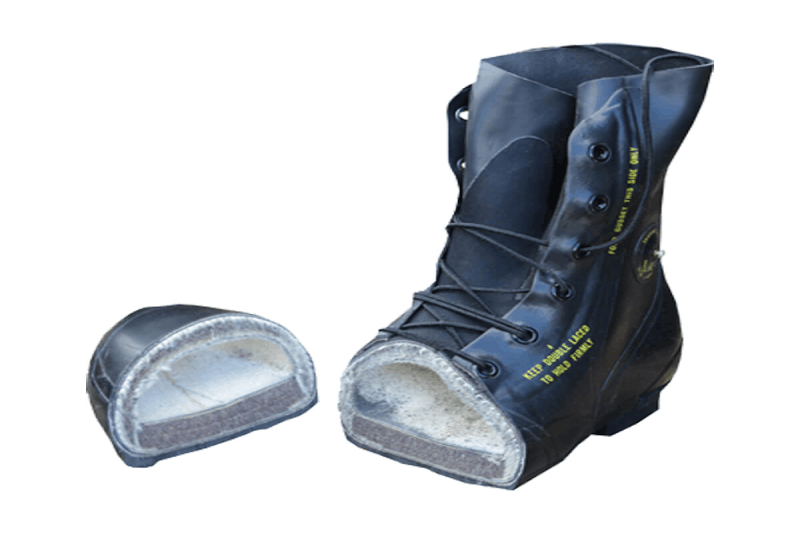
When soldiers were deployed to the coldest battlefields on Earth, frostbite wasn't just uncomfortable — it was mission-ending. Standard leather boots failed in arctic conditions, forcing the U.S. military to engineer a completely new category of footwear: extreme cold vapor barrier boots, now famously known as Mickey Mouse Boots and military bunny boots.
Today, these oversized winter boots are legendary among collectors, outdoorsmen, and cold-weather workers. But how did Mickey Mouse military boots earn their reputation as the most effective military winter boots ever created?
Let's dive into the origins, technology, and legacy of the boots that redefined survival in extreme cold.
Why They're Called Mickey Mouse Boots
The nickname "Mickey Mouse boots" comes from the boots' exaggerated, bulbous toe box — oversized to accommodate layers of socks and insulation while still allowing blood circulation.
Unlike traditional footwear, boots mickey mouse were never designed to look sleek. They were built to perform in environments where frostbite could set in within minutes.
Soldiers affectionately began calling them:
- Mickeys boots
- Mickey boots the military
- Mickey Mouse bunny boots
- Mickey Mouse timbs (a humorous comparison to oversized streetwear boots)
The name stuck — and decades later, the design remains instantly recognizable.
The Cold War & Birth of Vapor Barrier Boots
During the Korean War and later the Cold War era, U.S. forces stationed in Alaska, Korea, and Northern Europe experienced massive foot-injury rates due to freezing temperatures.
The Army needed a radical solution — not another insulated leather boot.
That solution was the military vapor barrier boot.
Instead of trying to "breathe," these boots:
- Completely sealed the moisture inside
- Prevented sweat from freezing in the insulation
- Created a controlled warm micro-climate around the foot
This breakthrough led to the creation of:
- Mickey Mouse boots military — rated to approximately -20°F (-29°C)
- Military bunny boots — rated to -60°F (-51°C)
What Makes Vapor Barrier Boots So Effective?
Traditional boots fail in extreme cold because:
- Sweat soaks insulation
- Moisture freezes
- Heat loss accelerates
Vapor barrier boots do the opposite.
Core Technology
| Feature | Function |
|---|---|
| Dual-wall rubber shell | Traps air for insulation |
| Sealed vapor barrier | Prevents moisture escape |
| Thick felt liner | Adds thermal buffering |
| Pressure relief valve | Balances internal air pressure |
| Wide toe box | Maintains circulation |
This system turned Mickey Mouse winter boots into the gold standard for sub-zero operations.
Mickey Boots vs Bunny Boots — What's the Difference?
| Boot Type | Color | Temperature Rating | Common Name |
|---|---|---|---|
| Black | Black | Down to -20°F | Mickey Mouse boots the army |
| White | White | Down to -60°F | White Mickey Mouse boots / Bunny boots army |
That's why you'll hear them referred to as:
- Army bunny boots
- Mickey boots white
- Bunny boots military
- Mickey boots the military
Each had a specific battlefield role.
Where Were Mickey Mouse Boots Used?
These weren't parade boots — they were field-proven survival gear.
Military Deployments
- Korea
- Alaska
- Arctic NATO bases
- Cold War Europe
- Antarctic research missions
The boots protected soldiers from:
- Trench foot
- Frostbite
- Hypothermia during extended immobility
That's why veterans still praise Mickey Mouse snow boots decades later.
Why Soldiers Loved — and Hated — Them
Advantages
- Near-zero frostbite risk
- Waterproof in deep snow
- Unmatched insulation
- Durable rubber shell
Disadvantages
- Heavy and bulky
- No breathability
- Requires moisture-management discipline
Wearing boots Mickey without proper sock rotation could lead to "sweat foot," but trained soldiers knew how to manage the system.
Are Mickey Mouse Boots Still Relevant Today?
Absolutely.
Modern outdoorsmen now hunt for:
- Mickey boots for sale
- Military vapor barrier boots
- Mickey Mouse military boots for ice fishing, snowmobiling, oil-field work, and arctic research.
No modern winter boot — no matter how advanced — matches the raw cold-weather reliability of a true Mickey boot.
How to Identify Authentic Army Mickey Mouse Boots
When buying surplus Mickey Mouse boots, look for:
- NSN or military contract markings
- Air-pressure valve on the side
- Thick dual-wall rubber construction
- Felt liners inside the shell
Avoid civilian knockoffs sold as "Mickey Mouse boots" — they rarely use true vapor barrier technology.
Why They're Still the Benchmark for Extreme Cold
Even today, many winter boot brands attempt to replicate the performance of extreme cold vapor barrier boots, but none match the military's sealed-system engineering.
That's why you'll still hear professionals refer to them as:
- Military boots Mickey Mouse
- Military Mickey Mouse boots
- Mickey Mouse winter boots
They aren't fashion items. They're survival equipment.
Final Thoughts
The story of Mickey Mouse bunny boots isn't just about footwear — it's about how necessity drove innovation in the harshest environments on Earth.
From Cold War outposts to modern ice-fishing shelters, these boots continue to prove that when it comes to extreme cold, nothing beats the original military vapor barrier boots.
And that's why, decades later, the legend of Mickey's boots still marches on through snow, ice, and history.