


A military sleeping bag is a rugged, often modular sleeping bag designed for armed forces use in harsh weather. It prioritizes durability and reliable insulation over minimum weight.
How to Choose a Military Sleeping Bag: A Practical Buyer's Guide

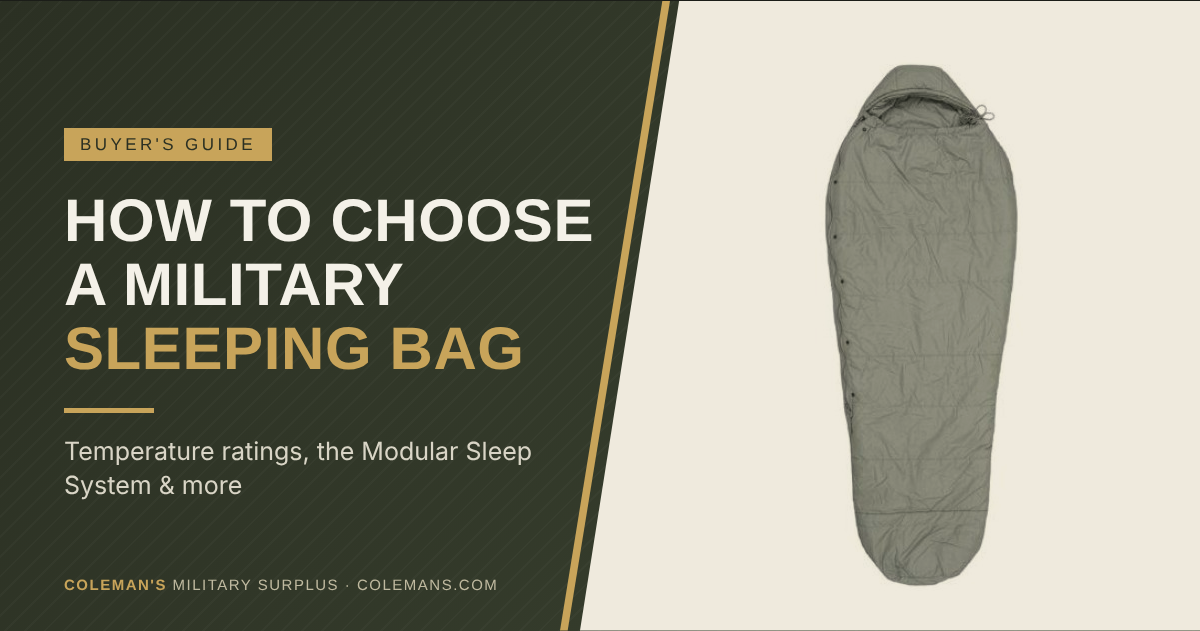
A good military sleeping bag is built for cold nights, rough handling and years of use. Whether you're camping, hunting, building an emergency kit or outfitting a scout troop, the right bag keeps you warm for far less than most retail outdoor brands charge.
This guide covers what to look for, how the military's modular system works, and how to match a bag to your conditions.
What Makes a Military Sleeping Bag Different?
Standard camping bags are usually designed around weight and packability for recreational use. Military sleeping bags are designed around reliability. They use tough ripstop nylon shells, hold up to repeated stuffing and rough ground, and are often part of a larger system rather than a single bag.
The trade-off is size and weight. Military bags are generally bulkier than ultralight backpacking bags, so they suit car camping, base camps, vehicles, cabins and emergency storage best. For long treks where every ounce counts, weigh that trade-off first.
Step 1: Know Your Temperature Range
Temperature is the first decision. Ask yourself what the lowest overnight temperature is where you'll use the bag, then choose a bag rated at or below it. If you sleep cold, go a step colder.
Retail guides commonly sort bags by season: roughly 30°F and above for summer, 15°F to 30°F for three-season use, and 15°F and below for winter. Treat these as starting points. Your own cold tolerance, clothing, shelter and sleeping surface all change the real-world result.
Many surplus bags carry older military ratings rather than modern lab-tested EN ratings, so use them as a guide and build in a safety margin if you'll be in freezing weather.
Step 2: Understand the Modular Sleep System
The U.S. military's Modular Sleep System (MSS) is a good model for choosing gear, because it solves the temperature problem with layers instead of one do-everything bag. It's commonly described as having these parts:
- Lightweight patrol bag: for mild conditions, commonly cited as roughly 35°F to 50°F on its own.
- Intermediate cold weather bag: for colder nights, commonly cited as roughly -5°F to 35°F on its own.
- Both bags combined: the two nest together for much colder protection, commonly cited down to around -30°F.
- Bivy cover: a weather-resistant outer layer that blocks wind and moisture and adds warmth.
- Compression sack: shrinks the system for storage and transport.
- Sleeping mats: insulate you from the ground.
You don't need the full system. Many people start with one bag, such as our U.S. G.I. Intermediate Sleeping Bag, and add a bivy or second bag if conditions demand it. Browse everything we carry in Military Sleeping Bags.
Step 3: Don't Skip the Ground Insulation
Heat escapes into the ground faster than into the air. The insulation under a bag gets crushed by your body weight, so a bag alone does little against cold earth. A foam or self-inflating mat is not optional in cold weather. A warm bag on bare frozen ground will still feel cold.
Pair your bag with a mat, a cot or a ground tarp. See our camping gear and bedding sections for sleep-system add-ons.
Step 4: Understand Sleeping Pad Insulation and Your Complete Sleep Setup
Why your pad matters as much as your bag. When you lie down, your body weight compresses the fill underneath you and it stops insulating. That means the pad under you, not the bag, is what protects you from the cold ground. A great bag on a thin or poorly insulated pad can still leave you cold.
What Is R-Value?
Pads are rated by R-value, a measure of how well they resist heat loss. A higher number means more insulation. As a general guide:
| Conditions | Suggested Pad R-Value |
|---|---|
| Warm summer nights | About 1 to 2 |
| Three-season camping (spring through fall) | About 2 to 4 |
| Winter, frozen ground or snow | About 4 to 5 and above |
Treat these as starting points. If you sleep cold, or you're on frozen ground or snow, choose a higher R-value.
Pad Types at a Glance
- Closed-cell foam pads: Lightweight, inexpensive and nearly indestructible. They can't be punctured, so they suit rugged, field-style use. They are bulkier to carry.
- Self-inflating pads: Foam and air combined for good comfort and insulation. A solid all-around choice for car camping and base camps.
- Air pads: Compact and comfortable, but they can puncture, and some have low insulation unless the R-value is listed.
- Cots: Cold air circulates under a cot, which can make you colder. Add a pad on top of the cot for insulation.
Pro tip: R-values add up. Two pads stacked together give you roughly the combined R-value, so layering a foam pad under a self-inflating pad is an easy, budget-friendly way to upgrade for winter.
Temperature Ratings Depend on the Whole System
A sleeping bag's temperature rating is not a promise that you'll be warm at that temperature. It assumes everything else is working in your favor. Your real-world warmth depends on your complete sleep setup:
- Ground insulation: the pad's R-value, as described above.
- Shelter: a tent, tarp or vehicle cuts wind and holds in heat. Open sky does not.
- Moisture: damp bags, condensation and sweat all reduce insulation.
- Clothing: dry base layers, wool socks and a hat add warmth. Avoid sleeping in damp clothes.
- Food and hydration: your body needs fuel to generate heat overnight.
- Your own cold tolerance: everyone sleeps differently, so adjust accordingly.
The best approach is to treat your bag, pad, shelter and clothing as one system. If you're between sizes or ratings, put your budget into the weakest link, which is often the pad, rather than only buying a colder bag.
Step 5: Compare Insulation Types
- Synthetic fill: the typical choice for military-style bags. It's heavier but keeps insulating when damp, dries faster, handles rough use and costs less.
- Down fill: lighter and more compressible, but expensive, and it loses loft when wet and dries slowly.
For field use, damp tents and unpredictable weather, synthetic is the more forgiving, budget-friendly option.
Step 6: Check Shell, Zipper and Shape
- Fabric: ripstop nylon resists small tears from spreading.
- Zipper: test it. A zipper that snags is miserable at 3 a.m. Look for a draft tube or baffle along the zipper line to block cold air.
- Shape: a mummy shape holds heat better because there is less empty space to warm. A rectangular bag is roomier and more comfortable but less efficient.
- Hood: a hood or drawcord around the head cuts heat loss significantly.
Step 7: Inspect Surplus Condition Honestly
Surplus gear varies. Used items have had a life, and unused items may have spent years in storage. Before relying on any bag in the cold:
- Unpack it and let it loft for a day.
- Check seams, stitching and the zipper.
- Smell it for mildew or moisture.
- Test it overnight in your backyard before a real trip.
If you have questions about condition or grade, contact our team and we'll tell you what to expect.
Step 8: Build Your Complete Sleep Setup
A sleeping bag works best as part of a kit. Consider pairing it with:
- A military tent or tarp for shelter
- A military duffel bag or backpack for transport
- A military wool blanket as an extra insulating layer
- Cold weather gear such as balaclavas, wool socks and gloves
Quick Buying Checklist
- Lowest expected temperature? Choose a bag rated at or below it.
- Staying near a vehicle or carrying it on foot?
- Do you have ground insulation?
- Is the zipper smooth and the fabric intact?
- Do you need a bivy or extra layers?
Frequently Asked Questions
What is a military sleeping bag?
What temperature are military sleeping bags rated for?
It depends on the model. Lightweight bags suit mild weather, while intermediate bags are built for cold. Layered together, systems like the MSS are commonly cited as handling extreme cold. Always check the individual bag's specifications.
Are military surplus sleeping bags worth buying?
For most campers and preppers, yes. They are durable and good value. They're heavier than ultralight backpacking bags, so they fit car camping and emergency use best.
How do I clean a military sleeping bag?
Follow the care label, wash gently, avoid harsh detergents, and dry it fully so the fill doesn't mildew.
Ready to gear up? Shop Military Sleeping Bags at Coleman's Military Surplus.


About the Author

Comments